You’ve flushed, the cistern has filled back up, and the water still won’t stop running.
Where that water ends up running to tells you a lot about whether you can fix it yourself, if so, how, and if not, how long you have to call the plumber before it floods your bathroom. Usually, if the water’s running into the bowl, the problem is almost always inside the cistern, and that’s a quick fix you can do yourself. But if it’s pooling on the floor, that’s a job for a plumber.
So before you book anyone, lift the cistern lid and try the checks below. There’s a good chance you’ll have it sorted in a few minutes.
TL;DR:
- Start by turning off the isolating tap behind the toilet. If it’s too stiff to turn, use the main stopcock at your water meter instead.
- Lift the cistern lid to see where the water’s going. Most running toilets come down to the inlet valve not shutting off or the outlet valve seal leaking.
- Water spilling into the overflow pipe: free the float or lower its setting, then replace the washer in the inlet valve if it’s still running.
- Water seeping into the bowl: clean the rubber seal on the outlet valve, then replace it if it’s cracked or hard.
- Flush button stuck down: reseat the lid and button, or shorten the push rods so they stop pressing on the valve.
- Call a plumber if a new washer or seal doesn’t stop the running, or if there’s water on the floor.
1. Turn off the isolating tap behind the toilet
Before you take the lid off, cut the water supply to the cistern so it doesn’t keep refilling while you’re trying to work out what’s wrong.
Every toilet has its own isolating tap for this, usually on the wall just behind or beside the cistern. Turn it clockwise as far as it goes, and it will stop the running. Most of these taps go years without anyone touching them, so it might feel a bit stiff. If it’s too stiff and won’t turn with a little force, leave it as is because older taps can snap.
If the tap won’t turn, or the water is leaking from the tap or the hose under the cistern, shut off the whole house at the main stopcock instead. You’ll find it at your water meter, usually near the front left or right corner of the property.
2. Lift the cistern lid to see where the water is going
With the water off, lift the lid off the cistern and set it down somewhere safe, like on a folded towel, because it’s ceramic and cracks easily. On some cisterns, you’ll need to unscrew the flush button first before the lid comes free.
Inside, there are two main parts to know about:
- The inlet valve sits to one side and lets water in. It has a float that rises with the water level and shuts the valve off once the cistern is full.
- The outlet valve sits in the middle at the bottom. It opens when you press the button and lets water rush into the bowl.
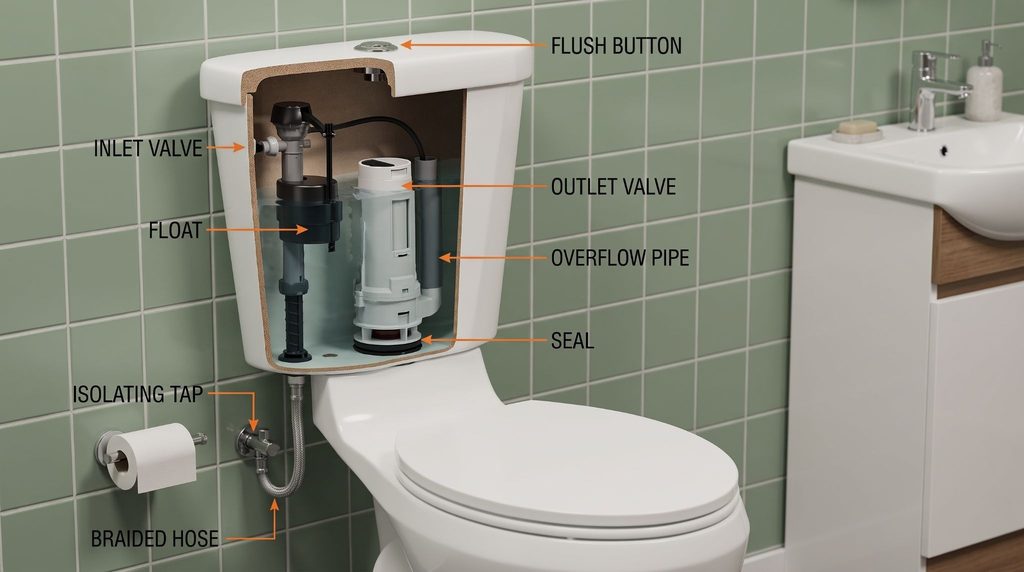
Nearly every running toilet comes down to one of these two not closing properly. To find out which one, turn the isolating tap back on for a minute and watch what the water does.
- Water spills into the overflow pipe: The level keeps rising until it runs into the pipe in the middle, which means the inlet valve isn’t shutting off.
- The cistern hisses and tops itself up: The level looks normal, but water is slowly slipping past the outlet valve into the bowl. To confirm it, add a few drops of food colouring to the cistern and leave it for 10 to 15 minutes without flushing. If colour shows up in the bowl, the outlet valve is leaking.
- The flush button sits low: If it doesn’t spring back up after you press it, it can hold the outlet valve open and keep the water running.
- Water ends up on the floor: Check the hose under the cistern and around the base of the toilet, because that leak is coming from outside the cistern.
3. Fix your running toilet based on what’s causing it
In Queensland, most plumbing work has to be done by a licensed plumber, but a few small cistern repairs are an exception, and anyone can do them. That covers freeing or adjusting the float, and replacing the float valve washer or the rubber seal on the outlet valve.
But replacing a whole valve, the hose, or the isolating tap is licensed work. Because a small mistake with any of these parts can turn into a slow leak that damages your floors or walls, and your insurer may not cover the damage if they find unlicensed plumbing work behind it. So while it may look like the job itself is too small to call a plumber for, what’s at stake if it goes wrong is not.
For each situation discussed below (matching signs found in the cistern check), we’ve covered what you can safely sort out yourself and when it’s better to leave it to a plumber.
1. Water running down the overflow pipe: the inlet valve isn’t shutting off
The inlet valve relies on the float to tell it when to stop. As the cistern fills, the float rises with the water, and once it reaches the right height, it closes the valve. If the float catches on the side of the cistern or the flush button rods, or it’s set too high, the valve never gets that signal. The water keeps rising until it spills into the overflow pipe.
The same thing happens when the small rubber washer inside the valve wears out, because the valve can’t seal properly even with the float in the right spot.
Check the float first
This is the easiest thing to rule out, so start here.
- Move the float up and down gently with your hand. If it catches on anything, nudge it clear.
- Look for a small clip or adjustment screw on the inlet valve. This sets how high the float sits, so lowering it a little makes the valve close before the water reaches the overflow.
- Turn the isolating tap back on and watch the cistern fill. If the water now stops below the top of the overflow pipe, you’ve fixed it.
Replace the washer if it’s still running
If the float moves freely and the water still won’t stop, the washer has most likely worn out.
- Turn the isolating tap off and flush to empty the cistern.
- Unclip the float if it’s in the way, then twist off the cap on top of the inlet valve and take out the old washer. Go gently, because the plastic parts can crack if you force them.
- Take the old washer with you to the hardware store so you get a matching one, then fit it and put the cap back on.
When to call a plumber
If a new washer doesn’t stop the running, the inlet valve itself has worn out and needs replacing, which must be done by a licensed plumber in Queensland.
The good news is that it can wait until morning. With the isolating tap off, the toilet isn’t wasting any more water, so you can book a daytime visit and avoid the after-hours call-out fee. Contact our team at Emergency Plumbers Townsville anytime, and we’ll come out the next day, whenever suits you, to fit a new valve.
Just don’t leave it for weeks, because a leaking toilet wastes water around the clock and adds to your water bill.
2. Water seeping into the bowl: the outlet valve seal has worn
The outlet valve has a rubber seal at its base that sits tight against the bottom of the cistern between flushes. Over time, that rubber perishes and loses its shape, or a bit of grit gets underneath and stops it sitting flat. Either way, water slips past it into the bowl, and the inlet valve keeps topping the cistern back up. That’s the faint hiss and refill you might hear every so often, even when nobody has flushed.
Clean the seal first
Sometimes the seal is fine, and something is just stopping it from closing properly.
- Turn the isolating tap off and flush to empty the cistern.
- On most cisterns, the outlet valve unclips or takes a small anticlockwise turn, then lifts straight out. Mark which side faces the front before you take it out, so it goes back the same way and your half and full flush buttons still line up. (If yours looks built into a frame, or has a pipe connected to it, leave it there, because that’s one for a plumber.)
- Wipe the rubber seal and the spot where it sits on the bottom of the cistern with a damp cloth, clearing away any grit or residue.
- Put the valve back, turn the tap on, and let the cistern refill. If the hissing stops and the dye test comes up clear, you’ve fixed it.
Replace the seal if it’s still leaking
If the rubber looks cracked, flattened, or has gone hard, a clean won’t be enough. The seal is just a rubber ring around the base of the valve, so with the valve out, pull the old one off, take it to the hardware store to find a match, and push the new one in its place.
When to call a plumber
If you’ve fitted a new seal and water still gets through, the outlet valve itself is likely cracked or warped and needs replacing. That’s a job for a plumber, the same as the inlet valve.
3. Flush button stuck down: the flush valve is being held open
On push-button cisterns, the button doesn’t touch the water at all. It sits in the lid and connects to the outlet valve through two plastic rods (or a cable on some models). Pressing the button pushes a rod down onto a paddle on top of the outlet valve, which lifts the valve and lets the water out. If the button sticks, or the rods are too long, they keep pressing on that paddle after you let go. The valve stays slightly open, and water keeps trickling into the bowl.
This usually happens after the lid has been off and gone back on slightly crooked, or after someone has fitted a new button or outlet valve.
Check the button and lid first
- Press each button a few times and watch whether it springs back up fully. If it’s sticky, wipe around the edges where it sits in the lid, because built-up grime can stop it returning.
- Lift the lid off and put it back on, making sure it sits flat and level. A lid that’s sitting crooked can push the rods down on one side.
- Listen to the cistern for a minute. If the hissing stops, that was the problem.
Adjust the rods if it’s still running
With the lid off, look at where the rods meet the paddles on top of the outlet valve. When the button is up, the rods should almost touch the paddles, with a gap of a couple of millimetres at most. If they’re pressing the paddles down even slightly, they’re too long.
- Most rods have a thread or a clip partway along, so you can shorten them a little without cutting. Turn or reclip them so they sit just above the paddles.
- Put the lid back on and press each button to check it still flushes. If a button now does nothing, the rod has gone too short, so lengthen it slightly.
- On cable-operated buttons, check the cable isn’t kinked or pulled tight, since that can hold the valve open in the same way.
When to call a plumber
If the button is cracked, a rod has snapped, or the paddles on the outlet valve are broken, you’ll need replacement parts. These vary between cistern brands and models, so a plumber can identify and fit the right ones. If the paddles turn out to be the problem, the fix is a new outlet valve, which is a plumber’s job either way.
As with the other cistern problems, this one isn’t urgent. Turn the isolating tap off and book a daytime visit.
4. Water on the floor: a burst hose or cracked cistern
Everything up to now happens inside the cistern, where any leak ends up in the bowl. Water on the floor means it’s escaping somewhere outside the cistern, and none of those leaks can be fixed with a washer or seal. What you can do in this situation is stop the water and work out how quickly you need a plumber.
Find and stop where the water is coming from
Dry the area first, then watch for a minute to see where fresh water appears.
- The braided hose. This is the flexible metal-braided hose that runs from the isolating tap up to the bottom of the cistern. It carries water at full mains pressure, so when it wears out, it can drip from the ends or burst along its length. Look for rust spots, bulging, fraying or kinks on the braiding.
- The isolating tap. Water beading or dripping around the tap itself, or where it meets the wall.
- The cistern. A hairline crack in the ceramic, often with a slow drip running down the outside.
- The base of the toilet. Water that pools around the base after you flush, rather than all the time. This comes from the seal between the toilet and the drain (that’s dirty water, so wear gloves when you mop it up)
Whichever it is, keep the isolating tap off and avoid using that toilet. If the tap itself is the leak, turn the water off at the main stopcock instead.
When to call a plumber
- Call straight away if you can’t stop the water, or the isolating tap is the one leaking. You’ll have to keep the whole house supply off until it’s fixed.
- It can wait until morning if the isolating tap has stopped a hose or cistern leak and there’s another toilet in the house. Leave the tap off and book a daytime visit.
- A leak at the base can also wait for a daytime booking, unless it’s your only toilet.
Call a licensed Townsville plumber for the bigger jobs
Most running toilets come down to a float, washer or seal, and you can often have it sorted before you need to call anyone. When it’s something bigger, like a valve that’s given out, a hose that’s let go, or water you can’t stop, our licensed plumbers can take it from there. That way the repair is done properly and won’t cause problems with an insurance claim later.
If water is escaping and you can’t stop it, call us now. We’re available 24/7 and can get a licensed plumber out to you fast. If it can wait until morning, give us a call and we’ll book a time that suits you.
FAQs
How much is an after-hours call-out?
At Emergency Plumbers Townsville, the after-hours call-out fee depends on the time and the job, and we confirm the price with you before any work starts.
Can I still use the toilet with the water turned off?
Yes. The cistern holds enough for one flush. To flush again, open the isolating tap for a few seconds to refill it, then turn it off again. If the tap is off at the main, pouring a bucket of water quickly into the bowl will flush it too.
How quickly can a plumber get to me?
We are available 24/7, day or night, and we’ll give you an arrival time when you call.
Do you come out to my suburb?
We cover all Townsville suburbs, plus the surrounding areas.
Will insurance cover damage from a burst toilet hose?
That depends on your policy, so it’s best to check with your insurer. To help with your claim, we can give you a written report that explains what caused the damage and details the repair work we carried out, so your insurer has everything they need to assess it.